Overview
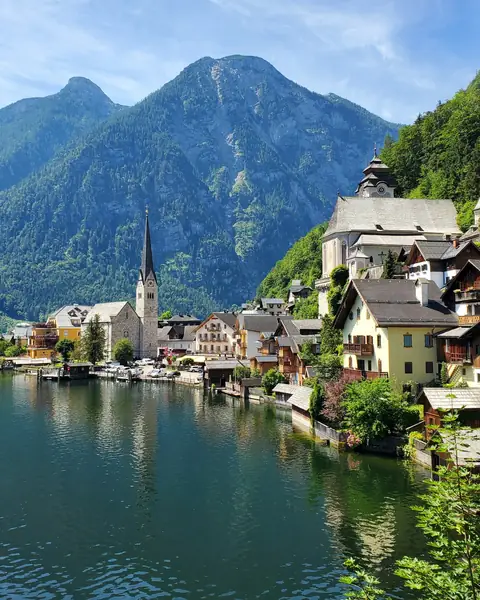
Hallstatt is a small village squeezed between Lake Hallstatt and a steep mountainside in the Salzkammergut region of Upper Austria. Together with the Dachstein massif above it, it forms part of the Hallstatt–Dachstein / Salzkammergut Cultural Landscape, a UNESCO World Heritage Site inscribed in 1997. Its salt mine, worked since prehistoric times, helped make the area rich.
The mountains are the draw for walkers and sightseers. From Obertraun, across the lake, the Dachstein Krippenstein cable car rises to about 2,100 m, with the 5 Fingers viewing platform and access to the Giant Ice Cave and Mammoth Cave. The Hoher Dachstein, at 2,995 m the highest peak in the range, can also be approached from the Styrian side by the Dachstein Glacier cable car at Ramsau.
Highlights
- The village centre, with its market square, church and lakeside views
- The salt mine tour, reached by funicular, and the Skywalk viewing platform above the village
- The Dachstein Krippenstein cable car and the 5 Fingers viewing platform at about 2,100 m
- The Giant Ice Cave and Mammoth Cave near Obertraun
Best time to visit
May to October is the main season, with the cable cars and trails open. July and August are warm but the village is very crowded around midday, so early mornings and evenings are far calmer. Autumn brings clear air and colour on the hillsides, and winter is quiet, with snow sports on the high plateau. Lift and cave opening dates change each year, so check before you go.
- JanJanuary: Not ideal
- FebFebruary: Not ideal
- MarMarch: Not ideal
- AprApril: Not ideal
- MayMay: Good
- JunJune: Best
- JulJuly: Best
- AugAugust: Best
- SepSeptember: Best
- OctOctober: Good
- NovNovember: Not ideal
- DecDecember: Not ideal
● Best · ○ Good · blank: not ideal. Conditions vary by year, so check local forecasts and access before you go.
Getting there
Fly to Salzburg (SZG), about an hour and a quarter by car. By train, services run from Salzburg via Attnang-Puchheim to Hallstatt station, which stands across the lake from the village; a short ferry meets the trains. Access to the village by car is restricted for non-residents, and visitors are usually directed to car parks outside it.
What to expect
Gentle sightseeing: cobbled lanes, short walks and cable-car viewpoints, all within a few hours of each other. Hallstatt is small and very popular, so expect crowds in peak months and queues at viewpoints. Higher paths on the Dachstein need good footwear, and snow can linger into early summer.
Practical tips
- Visit early or stay overnight to see the village without the day-trip crowds.
- Hallstatt is a living village: keep to public paths and keep noise down, especially in the evening.
- Combine Hallstatt with Obertraun and the Dachstein lifts, and ask about combination tickets for lifts and caves.
- Pack a jacket: the plateau at about 2,000 m is much colder than the lakeshore.
Frequently asked questions
Is Hallstatt worth visiting for the mountains?
Yes, if you add the Dachstein cable cars, ice caves and viewpoints to the village visit. Many people see only the village, but the high plateau is the real mountain experience.
How much time do I need?
A day trip covers the village and one cable car. Two nights allow the Dachstein plateau, the salt mine and some quieter lakeside walks.
Can I drive into Hallstatt?
Access to the old village is limited for non-residents, so visitors normally park outside and walk in. Check local rules and parking before you travel.
Official sources
Rules, fees, permits and conditions change. Check the official pages below before you travel.
Last reviewed October 2026. Details are for planning only and can change; confirm access, permits and conditions with official sources before you travel. Spotted something out of date? Tell us. Photography: Hasmik Ghazaryan Olson on Unsplash.


