Skip to content
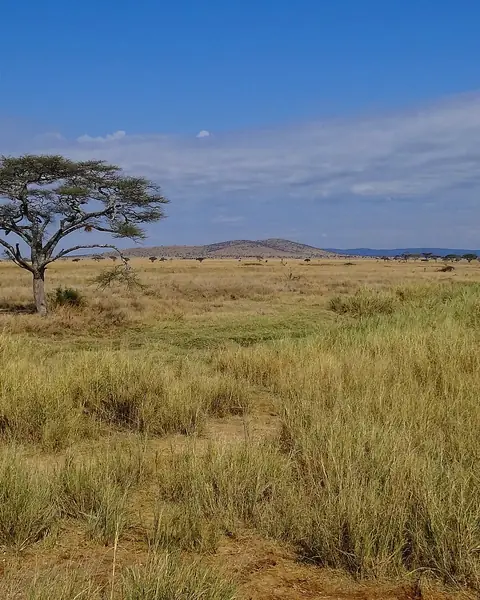
A lone acacia tree on the open grassland of the Serengeti

Mara and Simiyu Regions

Serengeti

Endless grass plains and acacia woodland, famed for the annual migration of more than a million wildebeest.

Altitude
1,500 m
Best months
Jun–Oct
Level
Easy
Fly into
Kilimanjaro (JRO)

Overview

The Serengeti National Park in northern Tanzania covers about 14,750 sq km of plains, woodland and rocky outcrops called kopjes. It is best known for the Great Migration, when more than a million wildebeest, along with zebra and gazelle, move in a loop across the Serengeti and the Maasai Mara in Kenya, following the rains.

Lions, cheetahs, leopards, elephants and many bird species live here year-round, and game drives are the main activity, with options for hot-air balloon flights and walking safaris in some areas. Different parts of the park are best at different times of year, so a good operator will plan according to where the herds are.

Highlights

  • The Great Migration, including river crossings in the north
  • Lions and cheetahs on the central plains
  • Hot-air balloon flights over the savanna
  • Kopjes and acacia scenery

Best time to visit

June to October is the dry season and the best time for game viewing, with river crossings usually in July to September in the north. December to March is the calving season in the south, with large herds and predators. April and May are the wet months, with fewer visitors.

  1. JanJanuary: Good
  2. FebFebruary: Good
  3. MarMarch: Good
  4. AprApril: Not ideal
  5. MayMay: Not ideal
  6. JunJune: Best
  7. JulJuly: Best
  8. AugAugust: Best
  9. SepSeptember: Best
  10. OctOctober: Best
  11. NovNovember: Not ideal
  12. DecDecember: Good

● Best · ○ Good · blank: not ideal. Conditions vary by year, so check local forecasts and access before you go.

Getting there

Fly to Kilimanjaro (JRO) or Arusha, then take a small plane to an airstrip in the Serengeti, or drive about 8 to 9 hours from Arusha. Most travellers book a safari with a licensed operator, who arranges the vehicle, guide and park fees. Check park fees and rules in advance.

What to expect

Easy. Game drives are in vehicles, but days can be long and hot. Roads are rough, and facilities range from basic camps to luxury lodges. Book early for the migration season.

Practical tips

  • Book lodging and your safari well in advance for July to September.
  • Ask your operator where the herds are before choosing a region and dates.
  • Take sun protection, a hat, binoculars and a camera with a zoom lens.
  • Follow park rules and keep a safe distance from wildlife.

Frequently asked questions

When is the Great Migration?

It moves through the year. River crossings are usually between July and September in the north, and calving is in the south from January to March.

Can I see the Big Five?

Yes, with luck. Rhinos are the hardest to see in the Serengeti.

How many days do I need?

At least three or four days to see a good range of the park.

Official sources

Rules, fees, permits and conditions change. Check the official pages below before you travel.

Last reviewed October 2026. Details are for planning only and can change; confirm access, permits and conditions with official sources before you travel. Spotted something out of date? Tell us. Photography: Bjørn Christian Tørrissen (CC BY-SA 3.0) via Wikimedia Commons.

Where to stay

Where to stay in Serengeti

Hotels in Serengeti are coming soon

We are adding the hotels, guesthouses and lodges that local owners register with us. Each one is reviewed before it appears here. Meanwhile, you can compare stays on our partner sites.

List your hotel Compare stays (opens a partner site in a new tab)

More in Tanzania

Keep exploring Tanzania

Snow-capped Mount Kilimanjaro seen across the savanna from Amboseli National Park in Kenya

Kilimanjaro Region, northern Tanzania

Mount Kilimanjaro

Africa's highest peak, climbed on multi-day treks that need fitness, acclimatisation and a guide, but no technical skills.

5,895 m · Jan–Feb · Jun–Oct · Challenging

Good for: Trekking

Mount Meru rising above farmland near Arusha, Tanzania

Arusha Region, northern Tanzania

Mount Meru & Arusha National Park

A three to four day volcano climb with wildlife on the lower slopes, often done before Kilimanjaro.

4,562 m · Jan–Feb · Jun–Oct · Challenging

Good for: Trekking

The grassy floor and steep wall of Ngorongoro Crater under a blue sky

Arusha Region

Ngorongoro Crater

A huge volcanic caldera with a floor of grassland, a soda lake and some of the densest wildlife in Africa.

2,300 m · Jun–Oct · Easy

Good for: Scenic views · Villages & culture

Lake Manyara seen from the escarpment above the park (photographed in 1973)

Manyara Region

Lake Manyara

A compact park beneath the Rift Valley escarpment, with a soda lake, groundwater forest and tree-climbing lions.

960 m · Jun–Oct · Easy

Good for: Lakes · Scenic views

A baobab tree on the dry savanna of Tarangire National Park

Manyara Region

Tarangire

A park of ancient baobab trees and large elephant herds, centred on the Tarangire river.

1,100 m · Jun–Oct · Easy

Good for: Scenic views

Ol Doinyo Lengai rising above an acacia-covered hill in northern Tanzania

Arusha Region

Ol Doinyo Lengai and Lake Natron

A cone-shaped, active volcano that erupts unusual black lava, above a red soda lake where flamingos breed.

2,962 m · Jun–Oct · Challenging

Good for: Trekking · Lakes · Scenic views

Misty mountain ridges in the Usambara Mountains

Tanga Region

Usambara Mountains

A cool, green mountain range in north-east Tanzania with walking trails, villages and rare wildlife.

2,300 m · Jun–Oct · Moderate

Good for: Trekking · Scenic views · Villages & culture

Forested slopes and a grassy clearing in the Udzungwa Mountains

Iringa and Morogoro Regions

Udzungwa Mountains

A park of old rainforest, waterfalls and rare primates, the largest of the Eastern Arc mountains.

2,576 m · Jun–Oct · Moderate

Good for: Trekking · Scenic views

Chimpanzees feeding in a tree in the Mahale Mountains

Kigoma Region

Mahale Mountains

A remote mountain range rising from Lake Tanganyika, with forest, white beaches and wild chimpanzees.

2,462 m · May–Oct · Moderate

Good for: Trekking · Lakes · Scenic views

Rolling green flower-covered hills of Kitulo National Park

Mbeya and Njombe Regions

Kitulo National Park

A high plateau of grassland and wildflowers, known as the Serengeti of Flowers, with orchids, proteas and rare birds.

2,600 m · Dec–Apr · Easy

Good for: Scenic views · Trekking

The volcanic cone of Mount Hanang above the savanna

Manyara Region

Mount Hanang

A quiet volcanic peak, the fourth highest in Tanzania, with a day-and-a-half climb through farmland and forest.

3,417 m · Jun–Oct · Challenging

Good for: Trekking · Scenic views