Skip to content
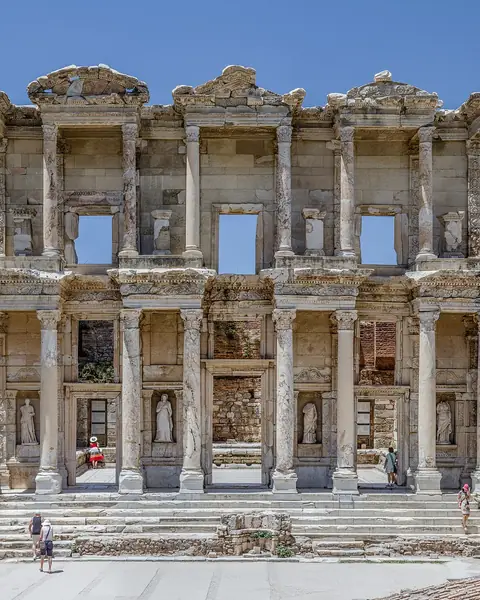
The two-storey facade of the Library of Celsus at Ephesus

Selçuk, Aegean Coast

Ephesus

One of the best-preserved Roman cities in the Mediterranean, with the Library of Celsus and a 25,000-seat theatre.

Altitude
30 m
Best months
Apr–Oct
Level
Easy
Fly into
İzmir (ADB)

Overview

Ephesus was one of the largest cities of the Roman world, a port and a centre of trade and religion on the Aegean coast. Its marble-paved streets, baths, houses and public buildings are among the best-preserved in the Mediterranean, and the site is now a UNESCO World Heritage Site. The two-storey façade of the Library of Celsus, completed in the 2nd century CE, is the most famous sight.

The Great Theatre could seat about 25,000 people, and the Terrace Houses, with their mosaics and wall paintings, show how wealthy residents lived. Nearby, the Temple of Artemis, once one of the Seven Wonders of the ancient world, is now a single reconstructed column, and the House of the Virgin Mary on the hill above is a place of pilgrimage. The nearby village of Selçuk and the hilltop village of Şirince make good bases.

Highlights

  • The Library of Celsus and the marble-paved Curetes Street
  • The Great Theatre, with seats for about 25,000
  • The Terrace Houses, with their mosaics and frescoes
  • The Temple of Artemis and the Basilica of St John in Selçuk

Best time to visit

April to October is the main season, with spring and autumn the best. Summer is very hot, and the marble paving is dazzling, so go at opening time or in the late afternoon. Cruise ships bring crowds in the middle of the day, so early or late visits are quieter.

  1. JanJanuary: Not ideal
  2. FebFebruary: Not ideal
  3. MarMarch: Good
  4. AprApril: Best
  5. MayMay: Best
  6. JunJune: Good
  7. JulJuly: Not ideal
  8. AugAugust: Not ideal
  9. SepSeptember: Best
  10. OctOctober: Best
  11. NovNovember: Good
  12. DecDecember: Not ideal

● Best · ○ Good · blank: not ideal. Conditions vary by year, so check local forecasts and access before you go.

Getting there

Fly to İzmir (ADB), about 1 hour by road from Selçuk, or to Istanbul (IST) and then on to İzmir. Trains and buses link İzmir with Selçuk, and from there minibuses and taxis go to the ruins. Many people combine Ephesus with a day trip from the coast.

What to expect

The main site takes two to three hours, with a lot of walking on uneven marble. Separate tickets are required for the Terrace Houses. There is little shade, so wear a hat and bring water. Guides are available at the gate.

Practical tips

  • Arrive at opening time to avoid the heat and the crowds.
  • Wear sturdy shoes: the marble is slippery and uneven.
  • Bring water, a hat and sun protection.
  • Consider a guide: the site is large and signs are limited.

Frequently asked questions

How long does a visit take?

About two to three hours for the main site, plus time for the Terrace Houses and the museum.

Where is the Temple of Artemis?

In Selçuk, a short drive from the main site, where a single column marks the spot.

Is Ephesus a UNESCO site?

Yes, it was inscribed in 2015.

Official sources

Rules, fees, permits and conditions change. Check the official pages below before you travel.

Photos

Visitors in front of the Library of Celsus
Carved capitals and columns against the sky at Ephesus

Last reviewed October 2026. Details are for planning only and can change; confirm access, permits and conditions with official sources before you travel. Spotted something out of date? Tell us. Photography: Benh LIEU SONG (CC BY-SA 3.0) via Wikimedia Commons, Slyronit (CC BY-SA 4.0) via Wikimedia Commons, Mehveuuum (CC BY-SA 4.0) via Wikimedia Commons.

Where to stay

Where to stay in Ephesus

Hotels in Ephesus are coming soon

We are adding the hotels, guesthouses and lodges that local owners register with us. Each one is reviewed before it appears here. Meanwhile, you can compare stays on our partner sites.

List your hotel Compare stays (opens a partner site in a new tab)

More in Turkey

Keep exploring Turkey

Bodrum Castle and the harbour with sailing boats

Bodrum, Aegean Coast

Bodrum

A white-washed harbour town on the Aegean, dominated by a medieval castle that holds an underwater archaeology museum.

10 m · May–Oct · Easy

Good for: Beaches & coast · History & ruins · Cities & landmarks

White travertine terraces and turquoise pools at Pamukkale

Pamukkale, Aegean Coast

Pamukkale and Hierapolis

Brilliant white travertine terraces of warm mineral water, beside the ruins of the Roman spa city of Hierapolis.

350 m · Apr–Oct · Easy

Good for: Scenic views · History & ruins

The Ölüdeniz lagoon between forested hills

Fethiye, Mediterranean Coast

Ölüdeniz and Babadağ

A turquoise lagoon backed by a mountain, with tandem paragliding from the top of Babadağ.

1,700 m · May–Oct · Easy

Good for: Beaches & coast · Scenic views · Trekking

The wooden horse replica at Troy

Çanakkale, Marmara

Troy

The ruins of the legendary city of the Trojan War, with nine layers of settlement and a large wooden horse.

30 m · Apr–Oct · Easy

Good for: History & ruins · Villages & culture

The Çanakkale Martyrs Memorial above lawns and pine trees

Gelibolu, Marmara

Gallipoli Peninsula

The battlefields, cemeteries and memorials of the 1915 campaign on a quiet, wooded peninsula.

30 m · Apr–Oct · Easy

Good for: History & ruins · Villages & culture

The harbour and white houses of Kaş below the mountains

Kaş, Mediterranean Coast

Kaş and Kekova

A small harbour town on the Lycian coast, with Greek island views, ancient tombs and a sunken city off Kekova.

10 m · May–Oct · Easy

Good for: Beaches & coast · Scenic views · History & ruins

Chalets and snow-covered slopes at the Uludağ ski resort

Uludağ National Park, Marmara

Uludağ

The highest mountain in north-west Turkey, with a ski resort above Bursa and forest trails in summer.

2,543 m · Dec–Mar, Jun–Sep · Moderate

Good for: Snow & ski · Scenic views · Trekking

The Great Mosque and the city of Bursa seen from the Tophane walls

Bursa, Marmara

Bursa

The first capital of the Ottoman Empire, with green-tiled mosques, silk markets and the slopes of Uludağ behind.

150 m · Apr–Oct · Easy

Good for: History & ruins · Villages & culture · Cities & landmarks

Hadrian's Gate between the old city walls of Antalya

Antalya, Mediterranean Coast

Antalya and Kaleiçi

A walled old town of Ottoman houses and a Roman harbour, with the Taurus Mountains rising behind the bay.

30 m · Apr–Oct · Easy

Good for: Cities & landmarks · Beaches & coast · History & ruins

The beach below the mountains at Olympos

Olympos and Çıralı, Mediterranean Coast

Olympos and the Chimaera

A forested valley of Lycian ruins running down to a pebble beach, with natural flames that burn on the hillside at night.

10 m · Apr–Oct · Moderate

Good for: History & ruins · Scenic views · Trekking

The courtyard of the Blue Mosque glowing at dusk

Sultanahmet, Istanbul

Blue Mosque (Sultan Ahmed Mosque)

A six-minaret mosque lined with blue İznik tiles, built in the early 17th century opposite Hagia Sophia.

40 m · Apr–Oct · Easy

Good for: Villages & culture · History & ruins

A vaulted arcade of shops in the Grand Bazaar

Beyazıt and Eminönü, Istanbul

Grand Bazaar and Spice Bazaar

One of the oldest and largest covered markets in the world, with thousands of shops, and the nearby Spice Bazaar.

40 m · Mar–Nov · Easy

Good for: Villages & culture · Cities & landmarks

See all 30 places in Turkey

Plan your trip

Everything you need for Turkey

These links open partner sites in a new tab. Prices and availability are set by the partners.

Bookings are coming soon. Reserve guided trips directly on LuxPines.

Join the waitlist