Skip to content
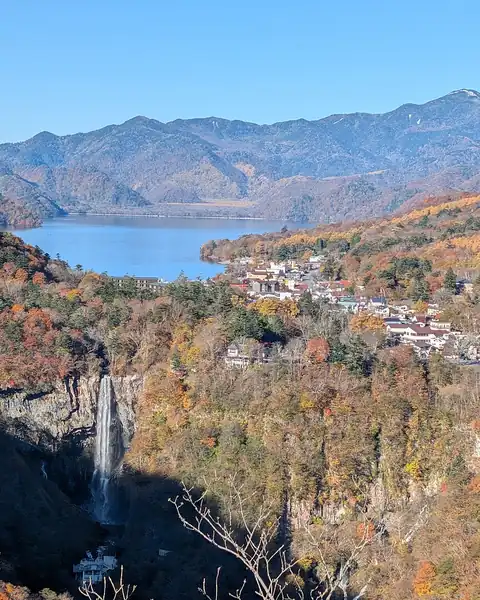
Kegon Falls and Lake Chuzenji among autumn forest at Nikkō

Tochigi

Nikkō

Ornate shrines in cedar forest below a mountain plateau of lakes, waterfalls and hot springs.

Altitude
1,269 m
Best months
Apr–Nov
Level
Easy
Fly into
Tokyo Haneda (HND)

Overview

Nikkō lies in the mountains north of Tokyo, in Nikkō National Park. The town is best known for Tōshō-gū, the lavishly decorated shrine of the shogun Tokugawa Ieyasu, part of a UNESCO World Heritage complex of shrines and temples among tall cedar trees.

Above the town, the Irohazaka road climbs in a series of hairpin bends to Lake Chūzenji at about 1,270 m and the 97 m Kegon Falls. Further on, Oku-Nikkō has hot springs, marshes and trails. Autumn colours here are among the earliest and most famous in Japan, so crowds are heavy in mid-October.

Highlights

  • Tōshō-gū shrine and the surrounding temples
  • Kegon Falls and Lake Chūzenji
  • The Irohazaka road, with its hairpin bends
  • Hot springs and marsh trails at Oku-Nikkō

Best time to visit

April to November is the main season. Cherry blossom comes in late April, summer is cool in the mountains, and autumn colour peaks in mid-October at Chūzenji. Winter is cold with snow, and some roads close.

  1. JanJanuary: Not ideal
  2. FebFebruary: Not ideal
  3. MarMarch: Not ideal
  4. AprApril: Best
  5. MayMay: Best
  6. JunJune: Good
  7. JulJuly: Not ideal
  8. AugAugust: Not ideal
  9. SepSeptember: Good
  10. OctOctober: Best
  11. NovNovember: Best
  12. DecDecember: Not ideal

● Best · ○ Good · blank: not ideal. Conditions vary by year, so check local forecasts and access before you go.

Getting there

Fly to Tokyo (HND), then take a limited express train from Asakusa or Shinjuku to Nikkō, about two hours. Buses connect the station with the shrines and the lake, and a discount pass can cover the area. In autumn, traffic on the Irohazaka road can be heavy.

What to expect

Easy. Most shrines and viewpoints are close to the roads, with many steps at the shrines. The mountain area is cooler than Tokyo, so take layers.

Practical tips

  • Go early in the day in autumn, when buses and roads are busy.
  • Allow at least a day for the shrines and another for the lake area.
  • Dress for cool temperatures, especially at the lake.
  • Check bus and rail passes for the best value.

Frequently asked questions

Can I visit Nikkō as a day trip from Tokyo?

Yes, but staying overnight gives time for the shrines and the lake.

When is the best time for autumn colour?

Usually mid-October at Lake Chūzenji, and later in the lower town.

How tall is Kegon Falls?

About 97 m.

Official sources

Rules, fees, permits and conditions change. Check the official pages below before you travel.

Last reviewed October 2026. Details are for planning only and can change; confirm access, permits and conditions with official sources before you travel. Spotted something out of date? Tell us. Photography: Joli Rumi (CC BY-SA 4.0) via Wikimedia Commons.

Where to stay

Where to stay in Nikkō

Hotels in Nikkō are coming soon

We are adding the hotels, guesthouses and lodges that local owners register with us. Each one is reviewed before it appears here. Meanwhile, you can compare stays on our partner sites.

List your hotel Compare stays (opens a partner site in a new tab)

More in Japan

Keep exploring Japan

Snow-capped Mount Fuji glowing at sunrise

Yamanashi & Shizuoka

Mount Fuji

Japan's highest peak, with an official climbing season from early July to early September.

3,776 m · Jul–Sep · Moderate

Good for: Trekking

Chureito Pagoda framing Mount Fuji above Fujiyoshida

Yamanashi

Chureito Pagoda & Fuji

A five-storey pagoda framing Mount Fuji, best in cherry-blossom and autumn-leaf weeks.

Fuji views · Apr · Nov · Easy

Good for: Villages & culture · Scenic views

A suspension bridge over the Azusa River with autumn larches and the Hotaka peaks at Kamikōchi

Nagano, Northern Alps

Kamikōchi

A clear-water valley in the Japan Alps, reachable only by bus or taxi, with easy riverside walks beneath jagged peaks.

1,500 m · mid-Apr–mid-Nov · Easy

Good for: Scenic views · Trekking · Lakes

Snow and a dark pool on the high Tateyama plateau in the Japan Alps

Toyama and Nagano

Tateyama Kurobe Alpine Route

A 37 km route across the Northern Alps by cable car, ropeway and trolley bus, famous for its huge snow walls in spring.

2,450 m · mid-Apr–Nov · Easy

Good for: Scenic views · Snow & ski

Mount Fuji, a pirate-style sightseeing ship and a red torii on Lake Ashi at Hakone

Kanagawa

Hakone

A mountain area of hot springs, lakes and volcanic valleys, an easy trip from Tokyo with views of Mount Fuji.

723 m · Year-round · Easy

Good for: Scenic views · Lakes · Villages & culture

A stone bridge among old cedars at Okunoin, Kōyasan

Wakayama

Kōyasan

A mountain-top temple community, the centre of Shingon Buddhism, with a vast forest cemetery and temple stays.

800 m · Apr–Nov · Easy

Good for: Villages & culture · Scenic views

Wooden merchant houses along the street of the old post town of Tsumago

Gifu and Nagano

Nakasendō: Magome and Tsumago

An 8 km walk on the old Nakasendō post road, linking two well-preserved Edo-period post towns.

801 m · Apr–Nov · Easy

Good for: Trekking · Villages & culture · Scenic views

Thatched farmhouses and rice fields in Shirakawa-gō seen from above

Gifu

Shirakawa-gō

A mountain village of steep thatched farmhouses, a UNESCO site that looks magical under winter snow.

500 m · Year-round · Easy

Good for: Villages & culture · Scenic views · Snow & ski

The wide grassy caldera of Mount Aso seen from the crater rim

Kumamoto, Kyushu

Mount Aso

A huge volcanic caldera on Kyushu, with five peaks, grassy plains and an active crater.

1,592 m · Apr–Nov · Easy

Good for: Scenic views · Trekking

Colourful volcanic slopes of Asahidake in the Daisetsuzan range

Hokkaidō

Daisetsuzan

The wild heart of Hokkaidō, with volcanic peaks, alpine meadows, hot springs and brown bears.

2,291 m · Jul–Sep · Moderate

Good for: Trekking · Scenic views · Snow & ski

Moss-covered rocks and ancient trees in the Shiratani Unsuikyo forest on Yakushima

Kagoshima

Yakushima

A round, mountainous island of ancient cedars, moss-covered forests and very heavy rain.

1,936 m · Mar–Nov · Moderate

Good for: Trekking · Scenic views