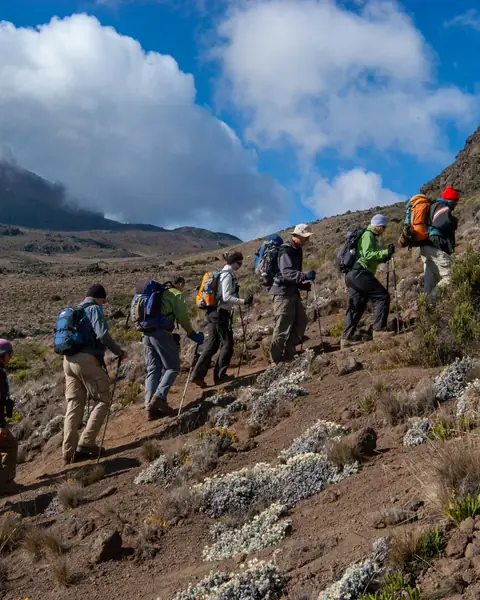
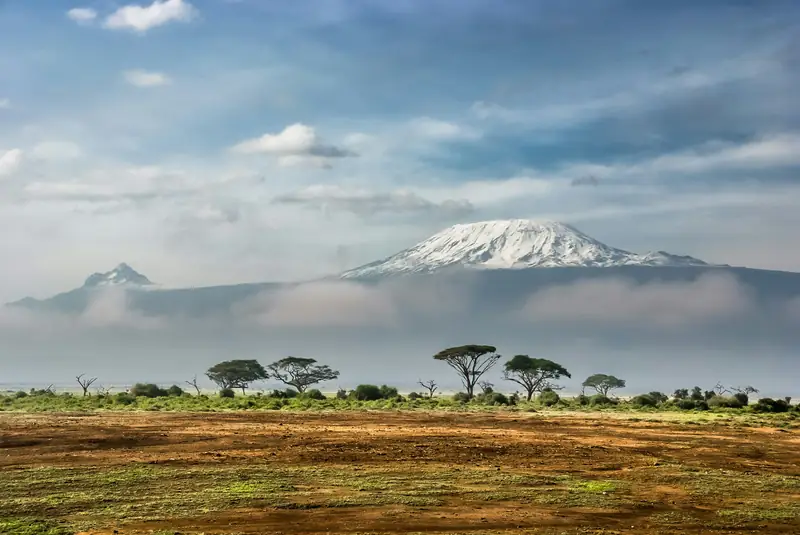
Kilimanjaro has no single route to the top. Several paths approach the summit from different sides of the mountain, each with its own gradient, scenery and number of days. The choice matters more than most people expect, because the number of days you spend climbing is the biggest factor in how well your body adjusts to the altitude.
All the standard routes finish at Uhuru Peak (5,895 m) and need no technical climbing skills. You must climb with a licensed guide, and most groups also hire porters and a cook.
The routes at a glance
| Route | Typical days | Where you sleep | Character |
|---|---|---|---|
| Marangu | 5 to 6 | Huts | The only route with huts. Same path up and down; short itineraries leave little time to adjust. |
| Machame | 6 to 7 | Camping | Scenic and popular, with the Barranco Wall and a "climb high, sleep low" profile. |
| Lemosho | 7 to 8 | Camping | Starts in forest on the west side, crosses the Shira Plateau and joins the Machame path. Quieter at first. |
| Rongai | 6 to 7 | Camping | Approaches from the north, near the Kenyan border, on a gentler gradient. Often drier. |
| Northern Circuit | 9 to 10 | Camping | The longest route, circling the mountain with long views and the best acclimatisation. |
| Umbwe | 5 to 6 | Camping | Steep and direct. Only for experienced, well-acclimatised climbers. |
Mweka is the usual descent route for most of the camping routes and is not used for ascents.
How the summit day differs
Routes that approach from the south and west, such as Machame, Lemosho, Umbwe and the Northern Circuit, usually start the summit push from Barafu Camp, at about 4,673 m, and reach the crater rim at Stella Point (5,756 m). Marangu and Rongai start from Kibo Hut, at about 4,700 m, and reach the rim at Gilman's Point (5,685 m). All routes then walk on to Uhuru Peak. The climb begins around midnight, so you see sunrise from the upper mountain.
Choosing a route
- If you want the best chance of reaching the summit: choose a longer route, of seven days or more. Lemosho and the Northern Circuit give the most time to adjust, and operators and climbers generally report better summit success on longer itineraries.
- If you want scenery: Machame, Lemosho and the Northern Circuit cross the most varied landscapes.
- If you want fewer people: Lemosho (at least early on), Rongai and the Northern Circuit tend to be quieter than Machame and Marangu.
- If you prefer a bed to a tent: Marangu is the only route with huts, though a longer stay on the mountain is still a good idea.
- If you are watching the budget: park fees are charged per day, so a longer climb costs more. Cutting days to save money usually reduces your chances of reaching the top.
Planning notes
- Choose your operator carefully. Look for a licensed operator that pays and treats porters fairly, carries a good medical kit and has clear altitude-monitoring and evacuation procedures.
- Check the current rules. Routes, gates and fees change, and routes are sometimes closed temporarily, for example after wildfires. Check with Tanzania National Parks or your operator before you book.
- Get medical advice early. Ask a doctor or travel clinic about altitude, vaccinations and malaria precautions at the lower altitudes, and make sure your insurance covers trekking to 6,000 m and evacuation. Read our guide to altitude sickness.
- Consider Mount Meru first. A climb of Mount Meru a few days before Kilimanjaro is a popular way to acclimatise.
Our Kilimanjaro guide has the best months, access and tips.
Sources and further reading
- Tanzania National Parks (TANAPA)
- Tanzania Tourist Board
- NHS: Altitude sickness
- UK government travel advice: Tanzania
Written by the LuxPines editorial team and last updated 24 October 2026. Conditions, prices and rules change, so confirm details with official sources before you travel. See how we work and our affiliate disclosure.