Overview
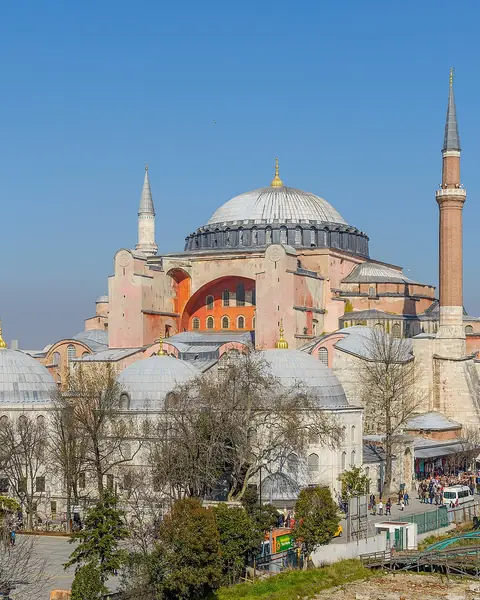
Hagia Sophia was built between 532 and 537 under the Byzantine emperor Justinian, and for almost a thousand years it was the largest cathedral in the world. Its vast central dome, about 31 m across, seems to float above a ring of windows, and it changed ideas about what a building could be. After the Ottoman conquest in 1453 it became a mosque, with minarets added outside, and in 1934 it opened as a museum. Since 2020 it has again been a mosque.
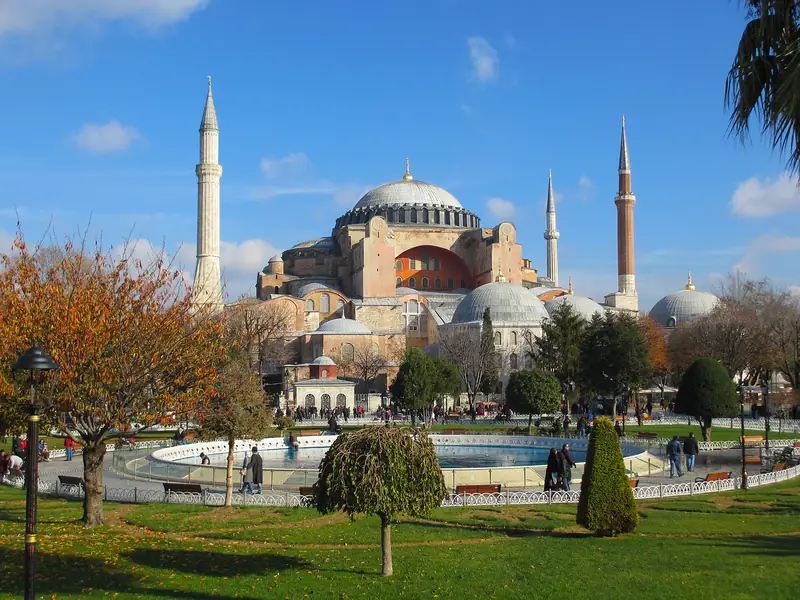
Inside, the great space glows with gold mosaics, huge calligraphy roundels and coloured marble, and the light shifts through the day. Visitors can see Byzantine mosaics of Christ, the Virgin and emperors in the upper gallery, and the Ottoman additions such as the mihrab and the minbar. It stands in the Sultanahmet district, facing the Blue Mosque across a park, and is one of the first places most visitors see.
Highlights
- The great dome and the light inside the nave
- Byzantine mosaics in the galleries and the entrance
- The Ottoman calligraphy medallions and the mihrab
- The view across the park to the Blue Mosque
Best time to visit
April to October is the main season, with long days and mild weather, though July and August are hot and very crowded. Spring and autumn are the best months, and winter is cool, damp and quieter. Go early in the morning, as queues build by midmorning.
- JanJanuary: Not ideal
- FebFebruary: Not ideal
- MarMarch: Good
- AprApril: Best
- MayMay: Best
- JunJune: Good
- JulJuly: Not ideal
- AugAugust: Not ideal
- SepSeptember: Best
- OctOctober: Best
- NovNovember: Good
- DecDecember: Not ideal
● Best · ○ Good · blank: not ideal. Conditions vary by year, so check local forecasts and access before you go.
Getting there
Fly to Istanbul (IST), then take the metro and tram: the T1 tram stops at Sultanahmet, a few minutes' walk from the entrance. Taxis are plentiful but traffic is heavy, and many hotels in the old city are within walking distance.
What to expect
Because it is an active mosque, access arrangements, ticketing and dress rules have changed in recent years, and parts of the building close at prayer times. Check the current rules before you go. Dress modestly, remove shoes on the carpets, and women cover their hair. Expect queues, security checks and crowds.
Practical tips
- Check the current entry rules, ticketing and prayer-time closures before you go.
- Arrive at opening time, or visit in the evening, to avoid the worst of the crowds.
- Dress modestly, with shoulders and knees covered, and carry a scarf.
- Keep your voice down and do not walk through the areas set aside for prayer.
Frequently asked questions
Is Hagia Sophia a mosque or a museum?
It has been a mosque again since 2020. Visitors are welcome outside prayer times, under rules that can change, so check before you go.
How old is the building?
It was completed in 537, about 1,500 years ago.
How long should I allow?
About an hour, plus time for the queue and the Blue Mosque next door.
Official sources
Rules, fees, permits and conditions change. Check the official pages below before you travel.
- Türkiye Tourism Promotion and Development Agency (Go Türkiye)
- Republic of Türkiye e-Visa
- UK government travel advice: Turkey
Photos

Last reviewed October 2026. Details are for planning only and can change; confirm access, permits and conditions with official sources before you travel. Spotted something out of date? Tell us. Photography: Arild Vågen (CC BY-SA 3.0) via Wikimedia Commons, Myrabella (Public domain) via Wikimedia Commons, Berlinaut (CC BY-SA 4.0) via Wikimedia Commons.


