Skip to content
The stone ruins of the Takht-i-Bahi monastery on its hilltop above the plain

Mardan, Khyber Pakhtunkhwa

Takht-i-Bahi

A UNESCO World Heritage monastery on a hilltop, one of the best-preserved Buddhist sites in Pakistan.

Altitude
150 m above the plain
Best months
Oct–Apr
Level
Easy
Fly into
Peshawar (PEW)

Overview

Takht-i-Bahi, a name usually translated as "throne of the spring", is a Buddhist monastery on a rocky hill about 15 km from the city of Mardan. It was founded in the early 1st century CE and was in use until about the 7th century, and the ruins are among the best-preserved examples of Gandharan Buddhist architecture in Pakistan. UNESCO listed it as a World Heritage Site in 1980.

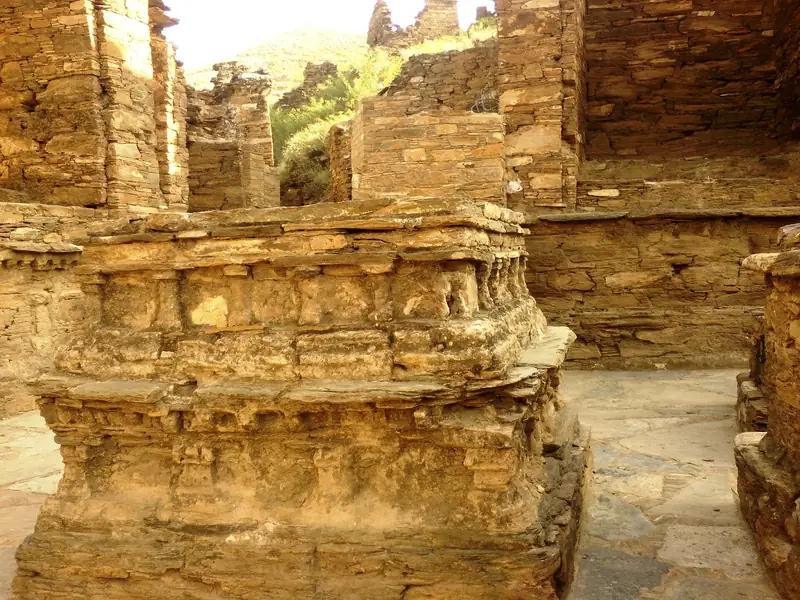
The complex includes a court of stupas, rows of monastic cells around a courtyard, an assembly hall and a later temple area, all built of stone and set in terraces on the hillside. From the upper walls, there are wide views across the plain. The site is quiet and open, with few facilities, and it is best seen early or late in the day, when the stone glows and the heat is less intense.

Highlights

  • The stupa court and the rows of monastic cells
  • Views over the plain from the hilltop walls
  • A UNESCO World Heritage Site of Gandharan architecture
  • Quiet paths, steps and terraces to explore

Best time to visit

October to April is the best period, with cooler weather and clear air. Summers are hot, and the stone absorbs the heat, so go very early if you visit then. Monsoon rain can make the steps slippery.

  1. JanJanuary: Best
  2. FebFebruary: Best
  3. MarMarch: Best
  4. AprApril: Best
  5. MayMay: Not ideal
  6. JunJune: Not ideal
  7. JulJuly: Not ideal
  8. AugAugust: Not ideal
  9. SepSeptember: Good
  10. OctOctober: Best
  11. NovNovember: Best
  12. DecDecember: Best

● Best · ○ Good · blank: not ideal. Conditions vary by year, so check local forecasts and access before you go.

Getting there

Fly to Peshawar (PEW) or Islamabad (ISB). From Peshawar, the site is about 75 km to the north-east by road, roughly 1.5 to 2 hours, via Mardan. From Islamabad, it takes about three hours by motorway. Local taxis and rickshaws run from Mardan to the village below the hill, and the final climb is on foot.

What to expect

There is a climb of about 150 m on steps and uneven paths from the village bazaar, so wear comfortable shoes. There is little shade and no cafe at the top, so carry water. A small ticket office and guide service operate at the entrance, and guides can explain the layout of the buildings.

Practical tips

  • Go in the morning or late afternoon, and take plenty of water.
  • Wear sturdy shoes and a hat: the stone steps are uneven and the sun is strong.
  • Hire a local guide at the gate for a better understanding of the ruins.
  • Do not climb on the walls, and take no fragments or stones from the site.

Frequently asked questions

How old is Takht-i-Bahi?

It was founded in the early 1st century CE and used until about the 7th century.

Is Takht-i-Bahi a World Heritage Site?

Yes, UNESCO listed it in 1980, together with the nearby ruins of Sahr-i-Bahlol.

How long should I allow?

About two hours for a relaxed visit, including the climb from the village.

Official sources

Rules, fees, permits and conditions change. Check the official pages below before you travel.

Photos

Aerial view of the walls and courtyards at Takht-i-Bahi
Stone walls and niches at Takht-i-Bahi in golden light

Last reviewed October 2026. Details are for planning only and can change; confirm access, permits and conditions with official sources before you travel. Spotted something out of date? Tell us. Photography: Asif Nawaz (CC BY-SA 3.0) via Wikimedia Commons, Muzamil Hassain Toori (CC BY-SA 4.0) via Wikimedia Commons, Shahabuddin648 (CC BY-SA 3.0) via Wikimedia Commons.

Where to stay

Where to stay in Takht-i-Bahi

Hotels in Takht-i-Bahi are coming soon

We are adding the hotels, guesthouses and lodges that local owners register with us. Each one is reviewed before it appears here. Meanwhile, you can compare stays on our partner sites.

List your hotel Compare stays (opens a partner site in a new tab)

More in Pakistan

Keep exploring Pakistan

Rows of small stupas at the Butkara Buddhist site in Swat

Mingora, Swat, Khyber Pakhtunkhwa

Swat Buddhist Heritage

The ruined stupas and carvings of ancient Swat, a major centre of Buddhism, with a museum and a giant rock-cut Buddha.

1,000 m · Mar–Nov · Easy

Good for: Villages & culture

A spillway channel and blue water of Tarbela Lake among green hills

Haripur, Khyber Pakhtunkhwa

Tarbela Dam and Lake

One of the largest earth-filled dams in the world, holding back the Indus in a wide reservoir an easy drive from Islamabad.

450 m · Oct–Apr · Easy

Good for: Scenic views · Lakes

The White Palace at Marghazar behind a lawn and tall trees

Swat, Khyber Pakhtunkhwa

Marghazar White Palace

A white palace built by the first ruler of Swat in 1940, set among gardens and trees beside a mountain stream.

1,000 m · Mar–Nov · Easy

Good for: Villages & culture · Scenic views

Sunset over the hills from the Malam Jabba ski resort

Swat, Khyber Pakhtunkhwa

Malam Jabba

Pakistan's best-known ski resort, a forested hill above Swat with a chairlift, a ski slope and views of the valley.

2,800 m · Dec–Mar, Jun–Sep · Easy

Good for: Snow & ski · Scenic views

Jarogo Waterfall dropping down a mossy cliff in a forested gorge

Matta, Swat, Khyber Pakhtunkhwa

Jarogo Waterfall

A tall waterfall that drops down a mossy cliff in a forested gorge in the Chatekal valley of Matta, in Upper Swat.

1,500 m · May–Oct · Moderate

Good for: Scenic views

Forested ridges and terraced slopes above the Miandam valley

Swat, Khyber Pakhtunkhwa

Miandam

A cool, forested hill resort in Swat, about 55 km from Mingora, with terraced slopes, small waterfalls and quiet walks.

1,900 m · Apr–Oct · Easy

Good for: Scenic views

The Dharmarajika stupa and monastery ruins at Taxila

Rawalpindi, Punjab

Taxila

A UNESCO World Heritage city of Buddhist stupas, monasteries and ancient ruins, about 35 km from Islamabad.

550 m · Oct–Apr · Easy

Good for: Villages & culture

The Swat River and the town of Madyan between forested mountains

Swat, Khyber Pakhtunkhwa

Madyan and Bahrain

Two river towns in the middle of the Swat Valley, with hotels, trout restaurants and bazaars on the way to Kalam.

1,350 m · Apr–Oct · Easy

Good for: Scenic views · Villages & culture

Islamabad seen from the Margalla Hills

Islamabad Capital Territory

Margalla Hills National Park

A national park on the edge of Islamabad, with forested hiking trails, viewpoints and wildlife a short drive from the city centre.

1,600 m · Oct–Apr · Moderate

Good for: Trekking · Scenic views

Green forest and the city of Islamabad seen from Daman-e-Koh

Islamabad Capital Territory

Daman-e-Koh

A hillside viewing terrace in the Margalla Hills, with a wide view over Islamabad, its green avenues and the Faisal Mosque.

650 m · Oct–Apr · Easy

Good for: Scenic views

Snow and fir forest on the slopes of the Lowari Pass

Chitral and Dir, Khyber Pakhtunkhwa

Lowari Pass and Tunnel

The high pass between Dir and Chitral, with a long tunnel that opened in 2017 and a winding road with views of forest and snow.

3,118 m · Jun–Oct · Moderate

Good for: Scenic views

Pine-covered slopes and a river in Kumrat Valley

Upper Dir, Khyber Pakhtunkhwa

Kumrat Valley

A green valley of deodar forest and meadows beside the Panjkora River, with a jeep road to high pastures and lakes.

2,000 m · May–Oct · Easy

Good for: Scenic views · Trekking

See all 114 places in Pakistan